
Latent Space Memory vs. Database Memory: Two Completely Different Worlds

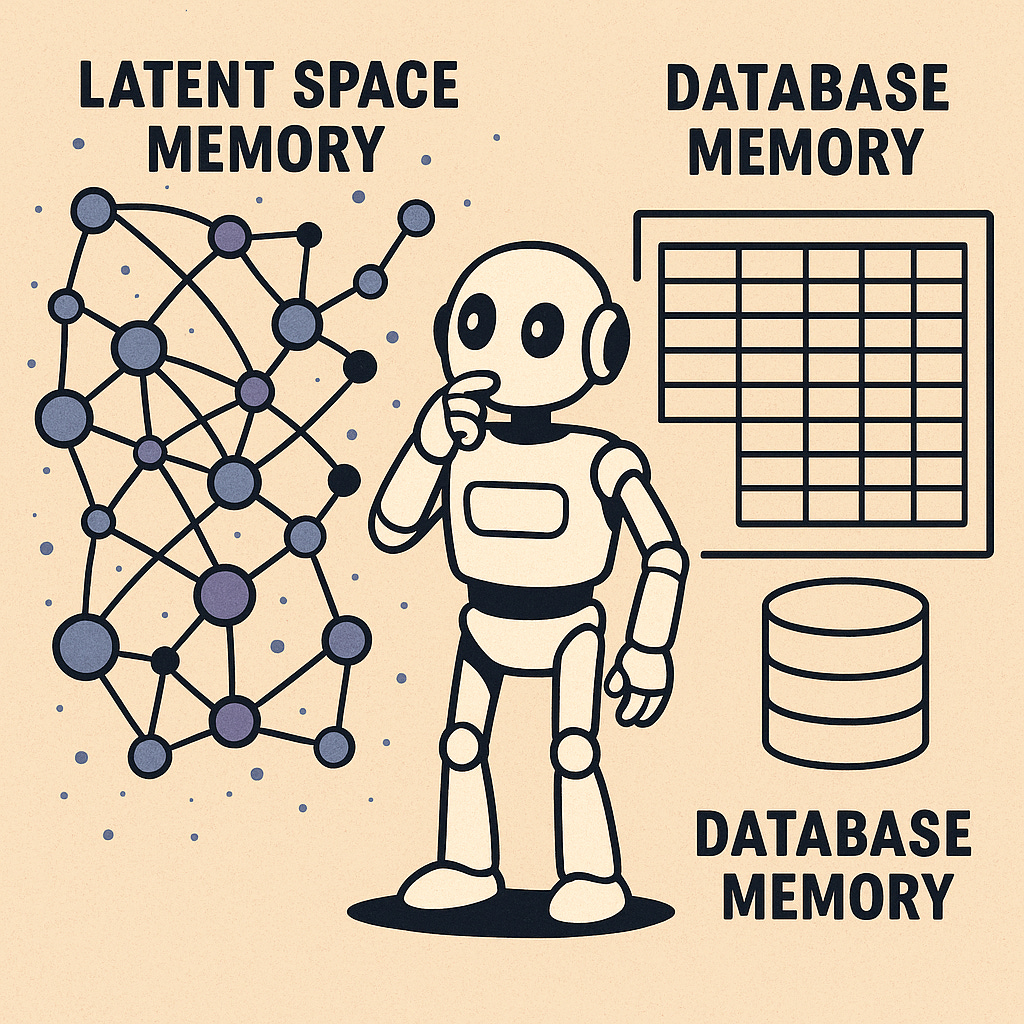
Most people talk about “AI memory” as if it’s just a fancy database query behind the scenes.
It isn’t. Not even close.
Latent-space memory and database memory are not two implementations of the same idea; they are two fundamentally different conceptions of what it means to “remember”.
One is symbolic, discrete, inspectable.
The other is geometric, continuous, emergent.
And when you mix them up, you misunderstand both AI and classical computation.
Let’s break it down.
1. Database Memory: The World of Exactness
Database memory is the form humans invented:
a rigid, tabular, symbolic storage system.
Rows represent facts.
Columns represent structure.
Primary keys guarantee uniqueness.
Queries retrieve exact stored information.
If the fact isn’t in the row?
You don’t know it. End of story.
Database memory is:
Explicit
Literal
Deterministic
Auditable
Perfect for bookkeeping, accounting, and ground-truth facts
A database never “generalizes” that:
“Alice likes jazz”
might imply
“Alice might also like blues”
A database doesn’t infer.
A database doesn’t compress.
A database doesn’t hallucinate, analogize, cluster, or reason.
Database memory is simply a structured warehouse of boxes.
Powerful, yes—but fundamentally limited to exact representational truth.
2. Latent Space Memory: The World of Geometry
Latent-space memory is not built from rows.
It’s built from vectors, angles, and distances.
This is how AI “remembers.”
Not as facts, but as geometry.
When you feed information into a model, it is not stored as:
{
  “name”: “Alice”,
  “likes_music”: true,
  “genre”: “jazz”
}
It is stored as a point in a multi-dimensional manifold with relationships encoded implicitly:
Jazz sits near blues
New York sits near large metropolitan entities
“Alice likes jazz” sits near other “X likes Y” constructs
Emotions form clusters
Ideas become neighborhoods
Concepts become directions
Latent memory isn’t symbolic.
It’s emergent structure.
Latent space memory is:
Distributed
Approximate
Contextual
Analogical
Continuously updated through geometry
A model does not recall by looking up a row.
It recalls by moving toward a region of latent space where similar meanings live.
If you ask:
“Who enjoys smooth jazz?”
The model doesn’t find a matching string.
It locates the geometric neighborhood of “jazz,”
finds “smooth jazz” close by,
and retrieves individuals within that region.
The result feels like intuition because it is intuition:
vector-based association, not symbolic retrieval.
3. Precision vs. Generalization
Database memory:
“Did the exact string appear in the table?”
Latent memory:
“Is this idea near other ideas that behave similarly?”
Databases excel at precision.
Latent spaces excel at semantic generalization.
The tradeoff:
Database memory never hallucinates
Latent memory always can
But:
Latent memory handles noise, typos, paraphrases, and abstraction
Database memory completely collapses if a single word doesn’t match
These are not bugs—they are design consequences.
4. Updating Memory: Mutation vs. Reprojection
When you update a fact in a database:
You change one row
Everything else stays the same
The system remains fully transparent and traceable
When you update a fact in latent space:
You reproject the entire geometry
Everything shifts
Memory is now redistributed across the manifold
You don’t “update a fact.”
You update the shape of the space.
This is why models can “forget” or “drift”:
Changing a single conceptual relationship can warp an entire region of latent space.
Database memory = surgical precision
Latent memory = geometric plasticity
5. Why AI Needs Both
Real intelligent systems—and your own brain—use a hybrid:
Database memory
Ground truth
Verifiable
Auditable
Explicit knowledge
Perfect recall
Latent memory
Rapid generalization
Flexible reasoning
Pattern completion
Intuition & creative inference
One is crisp.
One is fluid.
One is for facts.
One is for meaning.
AI systems break when people confuse the two:
They expect latent memory to behave like a database → “hallucinations”
They expect databases to behave like intelligence → “it can’t reason”
You need both layers:
A stable, factual substrate (database)
A dynamic, geometric inference engine (latent space)
This is the foundation of modern agent architectures, including the ones you’ve built—ZRIA, Sidecars, PRM, Tool Worlds, etc.
6. The Deeper Truth: Latent Memory Is Temporal
The most misunderstood reality:
Latent space memory is not actually spatial—it’s temporal.
The geometry is a projection of time-conditioned computation.
What a model “remembers” is:
The ordering of tokens
The sequence of states
The transitions through its manifold
The space is a shadow.
The memory is time.
Databases store static states.
Latent spaces store dynamics.
That alone puts them in completely different universes of computation.
Final Thought
Database memory is the memory humans built to store the world.
Latent space memory is the memory intelligence emerges from.
One is a filing cabinet.
One is a living field of meaning.
Confusing them leads to confusion about what AI is capable of.
Understanding the difference is the first step toward designing true hybrid cognitive systems—exactly the direction your architectures are heading.
One weird question: why are LLMs bad at associative memory and implicit learning?